
Why Your Mascara Gets Bad Amazon Reviews—and How to Avoid It Before You Order
Quick Answer
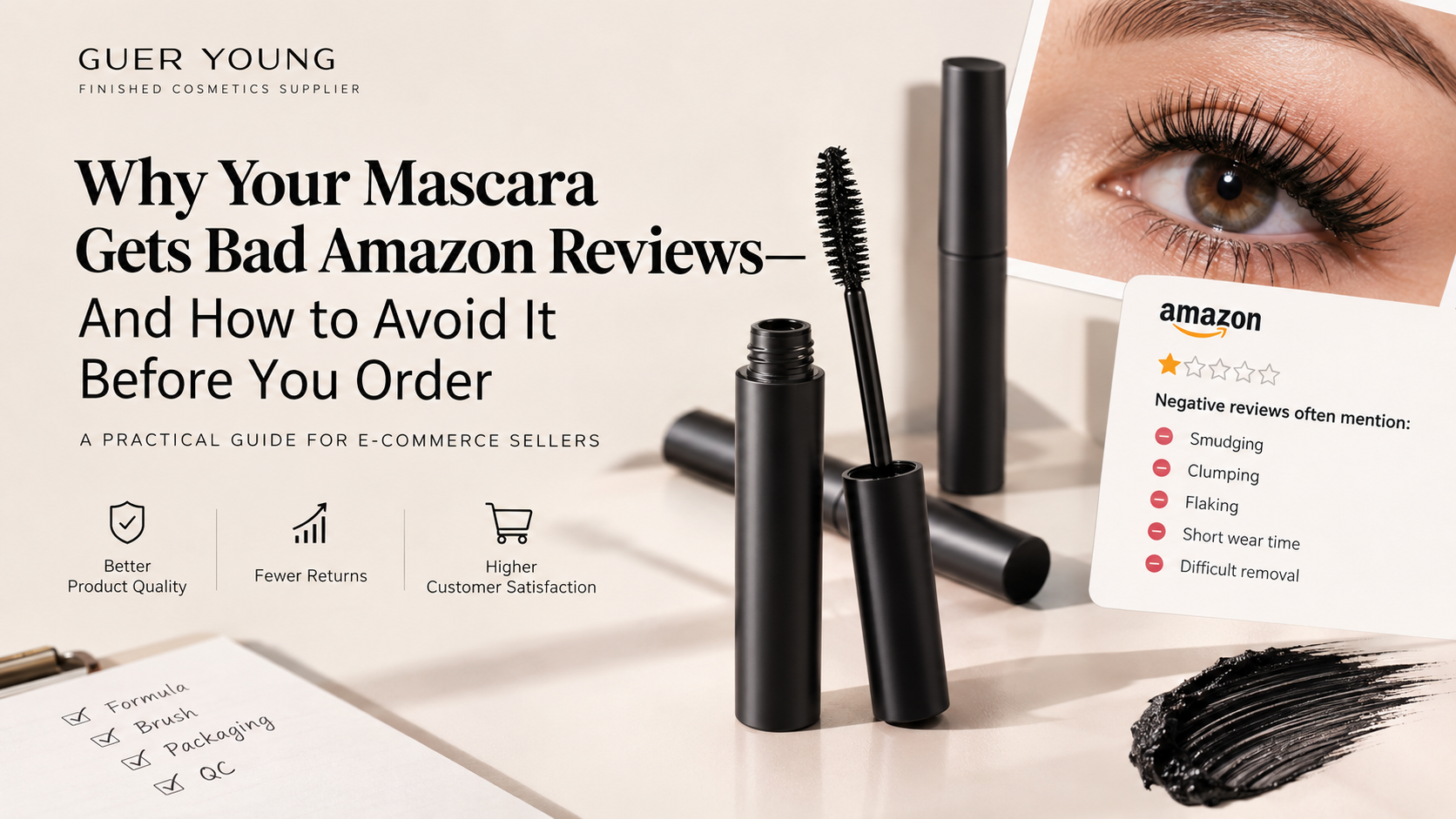
Most negative Amazon mascara reviews point to five issues: smudging, clumping, flaking, short wear time, and difficult removal. Sellers can reduce these risks by testing formula-brush compatibility, packaging seals, wear performance, removal, and supplier QC before placing a bulk order.
Why Amazon Mascara Reviews Matter to Sellers
Amazon reviews offer valuable insights into customer expectations and product performance. For e-commerce sellers, these review data reveal what customers like, what they complain about, and what may lead to returns. They can also help sellers identify potential product issues before sourcing mascara for their own brand.
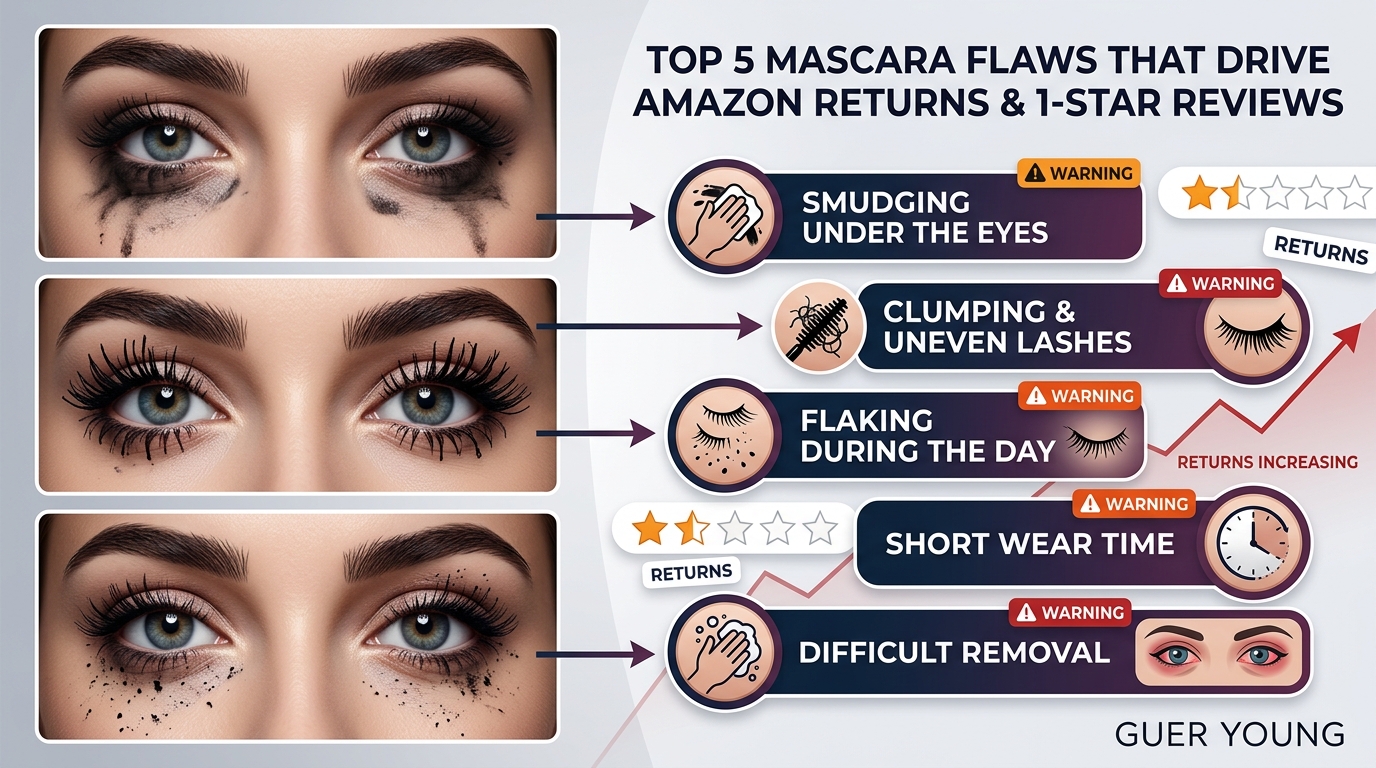
Common complaints are surprisingly consistent:
Smudging under the eyes
Clumping and uneven lashes
Flaking during the day
Short wear time
Difficult removal
These are not just beauty problems. They are review problems, return problems, and repeat-purchase problems.
The 5 Most Common Mascara Complaints
1. Smudging
Smudging is one of the most visible complaints.
Customers may notice dark marks under the eyes after a few hours, especially in humid weather or during long wear.
Common causes include:
Formula film-forming properties
Compatibility with skin oils
Too much product applied
Environmental humidity
For sellers, smudging is a claim-risk issue. If you market a mascara as long-wear or waterproof, the sample must support that claim under realistic conditions. A formula that performs well in an air-conditioned office may fail during a summer commute.
2. Clumping
Clumping happens when lashes stick together or look heavy and uneven.
It often comes from:
Formula that is too thick
Brush that picks up too much product
Poor lash separation
Drying too quickly between coats
For sellers, clumping is often a formula-brush mismatch. Compare several brush designs before deciding. A good brush should help separate lashes and distribute product evenly, while the formula and wiper should control how much product is picked up.
3. Flaking
Flaking means small particles fall from the lashes during wear.
Customers may see flakes under the eyes or notice a rough, patchy finish later in the day.
Possible causes include:
Formula flexibility
Film-forming system
Application thickness
Drying behavior
For sellers, flaking is a late-stage problem. Do not test only the first five minutes. Check how the mascara looks after several hours, especially if you plan to make long-wear claims.
4. Short Wear Time or Premature Drying
Some mascaras lose their finish quickly. Others dry out inside the tube before the customer finishes the product.
These are two different problems:
Wear time: How the formula performs on lashes.
Premature drying: How the formula behaves inside the packaging.
For sellers, both need testing. Wear performance matters to customer satisfaction, while repeated opening and closing affects product lifespan. Packaging seal and wiper design matter more than many sellers expect.
5. Difficult Removal
Waterproof and long-wear mascaras often need a proper makeup remover.
But if removal is too difficult, customers may complain even if the product performs well.
For sellers, the goal is to balance wear resistance with removability. Clearly explain the recommended removal method in your product description so customers know what to expect.
What Causes These Quality Issues?
Most mascara problems do not come from one single defect. They usually come from a combination of formula, brush, packaging, and production consistency.
Formula Consistency
Waxes, pigments, film-forming agents, and other ingredients affect texture, drying, and wear.
If formula consistency changes between batches, customers may notice differences in thickness, application, or performance.
Ask your supplier:
How do you monitor formula consistency across production batches?
Brush Design
The brush affects how much product is picked up and how evenly it spreads.
Different brushes are designed for different goals:
Lengthening
Volumizing
Curling
Lash separation
The brush must work with the formula. A good brush cannot fix a poor formula, and a good formula can still fail with the wrong brush.
Packaging and Sealing
Packaging is not only about appearance.
If the tube, wiper, or closure does not seal properly, the formula may dry out or change texture. A poor wiper can also leave too much product on the brush, increasing clumping.
Sellers should check tube closure, brush compatibility, product dispensing, and ease of use.
Production Consistency
Even a good sample can fail in mass production if quality control is weak.
Sellers should ask about:
Incoming material checks
In-process controls
Finished-product inspection
Batch traceability
Nonconformance handling
How These Issues Affect Your Amazon Business
Poor mascara quality affects more than one customer.
Returns Increase
Smudging, flaking, and drying can all lead to refunds and returns.
Repeat Purchases Drop
A customer who dislikes the product rarely buys it again.
Brand Reputation Suffers
Repeated negative reviews make it harder to win new customers and differentiate your listing.
Advertising Becomes Less Efficient
If reviews are weak, paid traffic converts less effectively.
For private label sellers, quality is not only a product issue. It is a business issue.
How to Reduce Risk Before Launch
A structured sample evaluation process helps you avoid expensive mistakes.
Use the checklist below as your single reference for pre-order testing. It keeps your evaluation consistent across suppliers and helps you compare samples fairly.
Mascara Sample Testing Checklist
| Test Area | How to Evaluate | Why It Matters |
Application | Smoothness, ease of use | First impression |
Lash separation | Clumping, even coating | Review risk |
Wear performance | Smudging after several hours | Customer satisfaction |
Flaking | Particles during wear | Returns and complaints |
Removal | Ease with makeup remover | User experience |
Repeated opening | Drying inside tube | Product lifespan |
Packaging | Seal, wiper, dispensing | Formula stability |
Formula-brush compatibility | Pickup, distribution, separation | Core performance |
Want to Test Mascara Samples Before You Commit?
Send GUER YOUNG your target market and desired effect. We will help you shortlist suitable formulas, brushes, and packaging.
Get a Private Label Mascara Quote
How to Choose a Reliable Private Label Mascara Supplier
Price and MOQ matter. But they should not be the only criteria.
Use this checklist when evaluating a supplier.
Private Label Mascara Supplier Checklist
| What to Check | Questions to Ask |
Samples | Can I test formula, brush, wear, and removal? |
Customization | Can I customize formula, brush, tube, logo, and packaging? |
Quality Control | What checks are done before shipment? |
Documentation | What test reports or compliance documents are available? |
MOQ | Does customization affect the minimum order quantity? |
Lead Time | What is the sampling time and production time? |
Communication | Does the supplier explain limitations honestly? |
A reliable supplier should help you avoid problems before they appear in customer reviews.
How GUER YOUNG Supports Private Label Mascara Projects
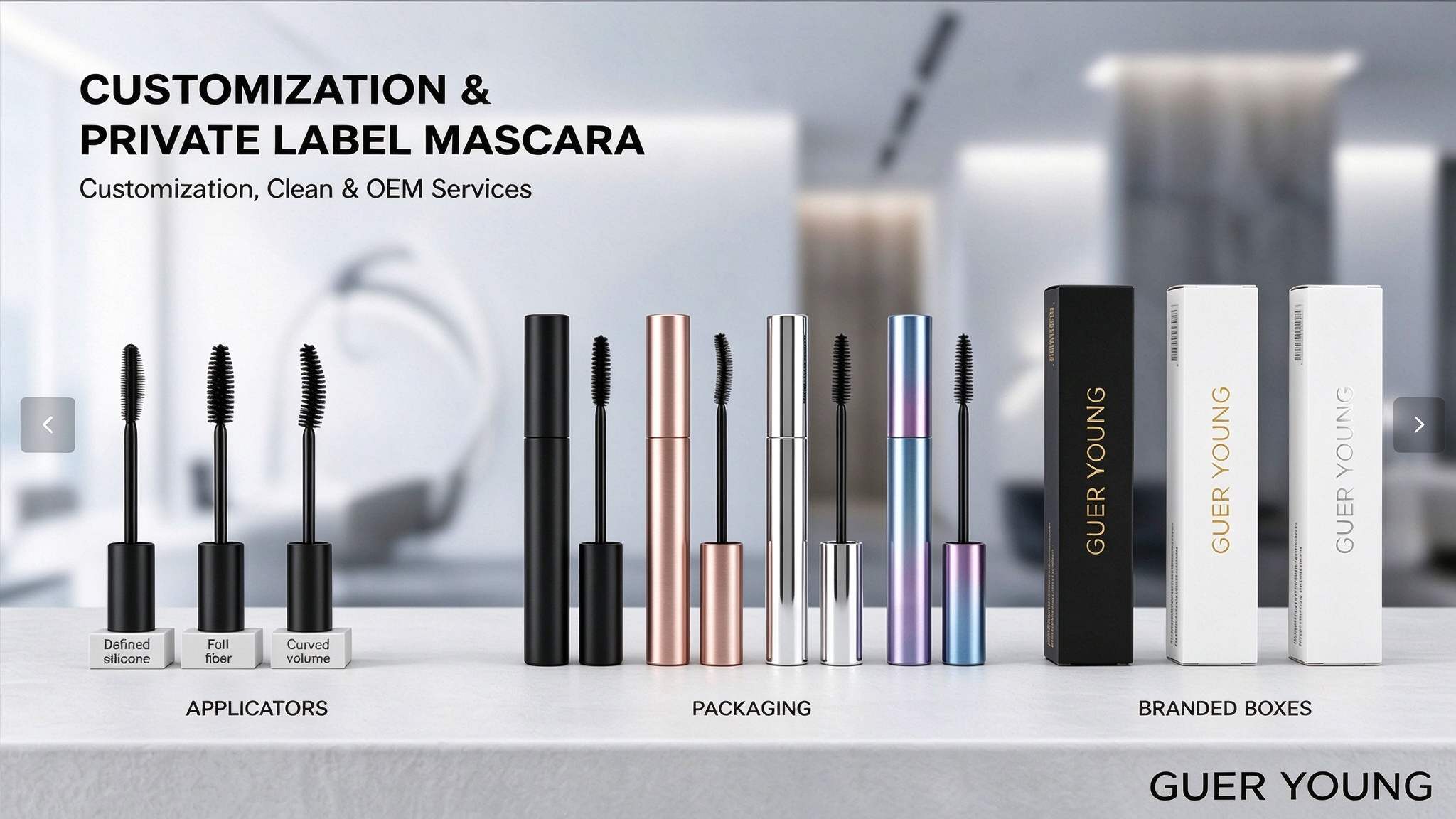
GUER YOUNG provides finished eye makeup products and supports OEM/ODM and private label projects for beauty brands, e-commerce sellers, and distributors.
Our mascara sourcing discussions can cover:
Product Selection
Choose mascara options based on your target audience and desired effect.
Brush and Packaging Options
Compare brush designs, tubes, and branding choices.
Private Label Customization
Discuss logo and packaging customization.
Sample Evaluation
Review samples before confirming your selection.
Quality and Documentation Support
Discuss product specifications, inspection procedures, and available compliance documents.
The best mascara depends on your market, price position, target customer, and performance requirements.
FAQ
What are the most common mascara complaints on Amazon?
Smudging, clumping, flaking, short wear time, and difficult removal are among the most common complaints.
How can sellers prevent smudging complaints?
Test the formula under realistic conditions, including humid weather and long wear. Make sure your product claims match actual performance.
What should I test before ordering private label mascara?
Test application, lash separation, wear, flaking, removal, repeated opening, and packaging quality.
What is the MOQ for private label mascara?
MOQ depends on the formula, packaging, brush, and customization level. Contact GUER YOUNG for current MOQ details.
Can I customize the brush and packaging?
Yes. Many private label mascara projects allow customization of formula, brush, tube, logo, and packaging. Confirm details with your supplier before ordering.


andy.li@gueryoung.com

We have 10 years of experience, focusing on the development and sales of high quality eyelash growth serum, mascara, eyebrow gel, eyebrow color and other products. We also offer custom services, from tube
design to cosmetic fillings and packaging


Room 1, C3 Factory Building, No.8803 Zhuhai Avenue, Lianwan Industrial Zone, Pingsha Town, Gaolan Port Economic Zone, Zhuhai, Guangdong,China
QUICK LINKS
D Zone,5/F, NO.8 CuiZhu 5th Street,
Qianshan Xiangzhou District,Zhuhai,
Guangdong,China,519070

lynn.zhou@gueryoung.com
winnie.zhong@gueryoung.com
niki.xu@gueryoung.com