
Why Do So Many Viral Mascaras Have Such a Short Lifecycle? Supply Chain Stability Is the Real Key
Read in English | Lire en Français | Leer en Español | Lesen auf Deutsch
In the beauty industry, viral products come and go fast.
A mascara can explode overnight thanks to TikTok creators, influencer reviews, or a successful product launch campaign. But just a few months later, sales begin to decline, negative reviews appear, and the once “must-have” product slowly disappears from the market.
Many cosmetic brands assume the problem is market saturation, declining trends, or consumers constantly chasing the next big thing. But in reality, one of the biggest reasons bestselling mascaras fail to sustain momentum is much less visible:
Supply chain instability.
For beauty brands in the US and European markets, supply chain consistency often determines whether a mascara becomes a short-term trend or a long-term hero product.
Why Viral Mascaras Often Fail So Quickly
Mascara is one of the most experience-driven products in the makeup category. Consumers care deeply about consistency and performance, including:
Lash volume and lengthening effect
Smudge-proof performance
Smooth application
Clump-free texture
Brush consistency
Eye sensitivity and comfort
The first purchase usually comes from marketing.
The second purchase comes from trust in product performance.
And that’s exactly where many brands run into trouble once a product starts scaling rapidly.
The Hidden Problem: Unstable Raw Material Supply
When a mascara suddenly goes viral, demand can increase far beyond expectations. At that point, many manufacturers begin facing serious supply pressure, such as:
Core wax materials becoming unavailable
Film-forming agents running out of stock
Pigment quality variations between batches
Delayed brush component production
Packaging inconsistencies
To keep production moving, some factories are forced to switch raw materials or adjust formulations temporarily.
On paper, it’s still the same product.
But for consumers, the performance feels completely different.
Once Product Quality Changes, Negative Reviews Spread Fast
Consumers in Western beauty markets are extremely sensitive to changes in cosmetic quality — especially for eye makeup products.
The moment users experience issues like:
Formula drying out too quickly
Clumping after several uses
Smudging under the eyes
Weak curl retention
Difficult removal
Eye irritation
negative reviews begin piling up immediately.
Today, whether on Amazon, TikTok Shop, Sephora reviews, Instagram, or independent DTC websites, bad feedback spreads incredibly fast.
Many brands eventually realize:
Their product didn’t lose to competitors — it lost to inconsistent supply chain management.
Once customers start questioning product consistency, repeat purchase rates decline rapidly, customer acquisition costs rise, and even strong marketing campaigns become less effective.
Long-Lasting Bestsellers Are Built on Stable Supply Chains
If you look at mascara products that remain successful for years in the US and European markets, they usually share one important characteristic:
Consistency.
Consumers continue repurchasing because:
The formula performs the same every time
The texture remains stable
The brush quality doesn’t change
The product experience feels reliable batch after batch
Behind that consistency is a strong and professional supply chain system.
For beauty brands, a reliable manufacturing partner should offer far more than simple OEM production.
1. Stable Raw Material Management
A mature cosmetics supplier should have:
Long-term raw material partnerships
Backup sourcing solutions
Ingredient validation systems
Risk forecasting capabilities
Many low-cost factories focus only on pricing and temporary sourcing advantages.
But eye makeup products are highly sensitive to formulation changes. Even small raw material adjustments can directly affect user experience.
2. Strong Batch Consistency Control
In today’s social-media-driven market, consistency matters more than ever.
One TikTok video comparing “old batch vs. new batch” can seriously damage a brand’s reputation.
That’s why experienced manufacturers invest heavily in:
Standardized emulsification systems
Precise filling processes
Viscosity control
Brush compatibility testing
Long-term stability testing
These systems help ensure every batch delivers the same quality consumers expect.
3. Fast and Reliable Scaling Capability
One defining characteristic of viral products is how quickly demand can spike.
A beauty brand may initially prepare inventory for 5,000 units — only to suddenly need 100,000 more after one influencer video goes viral.
At that stage, the real challenge becomes:
Can the supplier scale production without sacrificing quality?
If the answer is no, brands often face:
Stock shortages
Shipping delays
Formula substitutions
Increased defect rates
Customer dissatisfaction
And once customer trust is lost, it’s difficult to recover.
More Beauty Brands Are Prioritizing Supply Chain Security
Over the past few years, more US and European beauty brands have started realizing something important:
The biggest risk is not failing to create a viral product.
The biggest risk is failing to support it after it scales.
Especially in eye makeup, where consumers have very low tolerance for inconsistency, brands are becoming more selective about manufacturing partners.
Today, many cosmetic brands evaluate suppliers based on:
Formula stability
Long-term raw material availability
R&D capability
Regulatory compliance
Quality control systems
Scalable production capacity
Because sustainable growth depends on much more than marketing alone.
From Manufacturing Products to Building Long-Term Bestsellers
For independent beauty brands and DTC cosmetic companies, the ideal supplier is no longer just a factory that produces products.
It’s a long-term strategic partner that can support growth, maintain consistency, and protect brand reputation as demand scales.
At GUER YOUNG, we specialize in eye makeup manufacturing for global beauty brands, including mascaras, eyelash serums, eyeliners, and brow products. We also provide solutions for lip makeup, face makeup, and skincare categories.
More importantly, we focus on helping brands:
Extend bestseller product lifecycles
Reduce quality fluctuation risks
Improve repeat purchase rates
Maintain stable customer satisfaction
Scale successfully without sacrificing product consistency
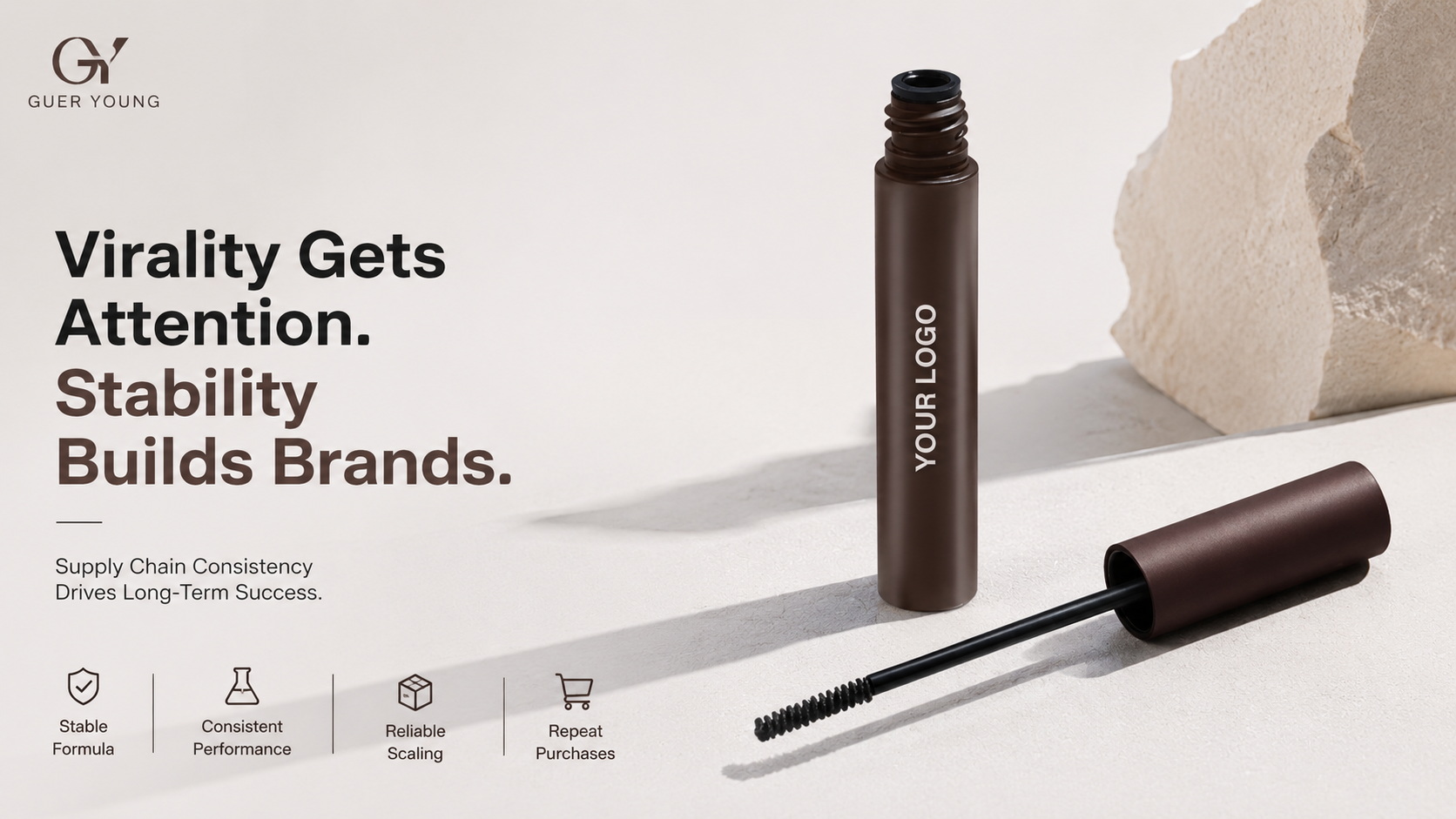
In today’s highly competitive beauty market, viral marketing may create attention — but a stable supply chain is what truly builds lasting brands.


andy.li@gueryoung.com

We have 10 years of experience, focusing on the development and sales of high quality eyelash growth serum, mascara, eyebrow gel, eyebrow color and other products. We also offer custom services, from tube
design to cosmetic fillings and packaging


Room 1, C3 Factory Building, No.8803 Zhuhai Avenue, Lianwan Industrial Zone, Pingsha Town, Gaolan Port Economic Zone, Zhuhai, Guangdong,China
QUICK LINKS
D Zone,5/F, NO.8 CuiZhu 5th Street,
Qianshan Xiangzhou District,Zhuhai,
Guangdong,China,519070

lynn.zhou@gueryoung.com
winnie.zhong@gueryoung.com
niki.xu@gueryoung.com