
Why So Many Private Label Makeup Brands Fail — And Why MOQ Is Usually the Real Problem
Read in English | Lire en Français | Leer en Español | Lesen auf Deutsch
For many emerging beauty brands in Europe and North America, private label cosmetics look like the fastest and safest way to enter the market. Compared with developing products from scratch, private labeling offers lower startup costs, faster launch timelines, and easier market testing.
But in reality, many indie beauty brands struggle long before they ever become profitable.
The issue is often not poor product quality, weak branding, or lack of demand.
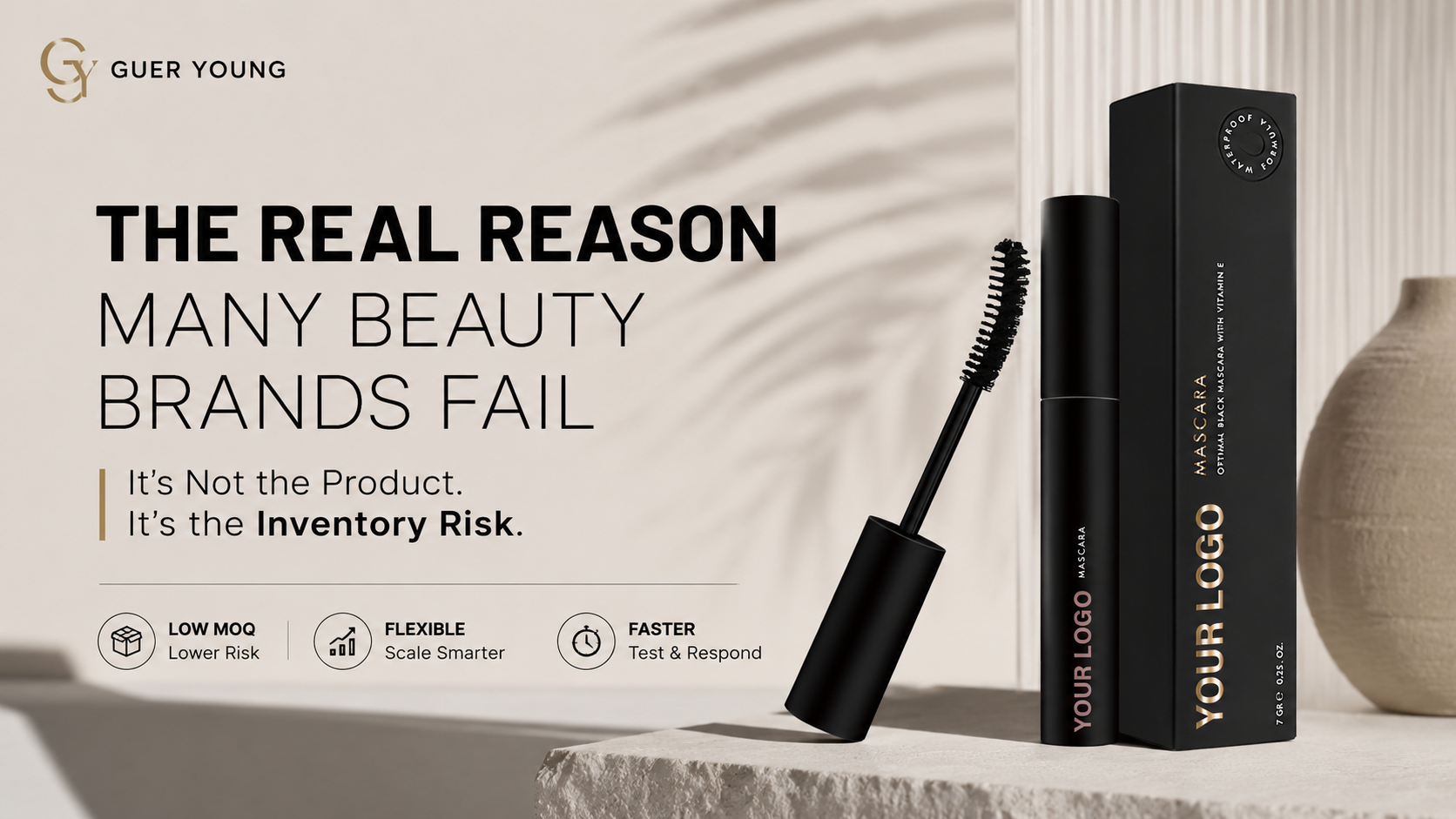
More often, the real problem starts with one thing: MOQ (Minimum Order Quantity).
Especially in categories like mascara, eyeliner, brow products, and lash serums, many manufacturers require brands to commit to thousands — sometimes tens of thousands — of units per SKU before production even begins.
For established brands, this may be manageable.
For startup beauty brands, it can become a serious financial trap.
High MOQs Are Creating Huge Pressure for Emerging Beauty Brands
Most independent beauty founders start with uncertain sales forecasts.
Their Shopify store is still growing. TikTok campaigns may go viral one week and slow down the next. Influencer collaborations don’t always convert consistently. Customer acquisition costs fluctuate constantly.
But despite this uncertainty, many suppliers still require:
10,000 mascaras per order
5,000 eyeliners per shade
Large custom packaging commitments
High upfront production deposits
The result?
Brands end up sitting on large amounts of inventory before they’ve even validated product demand.
At first glance, higher MOQs may seem attractive because they reduce unit costs.
But for early-stage brands, lower unit pricing rarely offsets the financial risk of excess inventory.
Because unsold inventory doesn’t just take up warehouse space — it drains cash flow.
And for startup beauty brands, cash flow is everything.
Inventory Pressure Can Kill a Brand Before It Scales
The beauty industry is heavily driven by marketing.
New brands need continuous investment in:
TikTok creators
Meta advertising
Instagram content
Product photography
Email marketing
Fulfillment and logistics
When too much capital is locked into inventory, brands lose the flexibility to continue growing.
Many beauty startups don’t fail because customers dislike the products.
They fail because they run out of cash before the brand gains momentum.
Beauty Trends Move Too Fast for Large Inventory Risks
The Western beauty market changes incredibly quickly.
A mascara trend that performs well today may lose traction within months. Consumer preferences constantly shift between:
Natural lashes vs dramatic volume
Clean beauty vs performance-driven formulas
Minimal packaging vs luxury aesthetics
Waterproof vs tubing formulas
If brands are forced to hold large amounts of inventory, they lose the ability to adapt quickly.
Instead of launching new products and testing trends, they spend months trying to clear old stock.
Over time, this slows innovation and weakens competitiveness.
Successful Beauty Brands Test Before They Scale
One of the biggest mistakes new beauty brands make is assuming they need large inventory from day one.
In reality, modern DTC beauty brands grow differently.
Today’s smartest brands typically follow this model:
Small launch → Test customer response → Improve the product → Scale winning SKUs → Expand gradually
This approach dramatically reduces risk.
And it works especially well for eye makeup products, where customer feedback is immediate and measurable.
For example, brands can quickly test:
Different mascara brush styles
Eyeliner tip designs
Brow product shades
Lash serum formulas
Packaging concepts
Without low MOQ flexibility, this type of testing becomes expensive and difficult.
That’s why more indie beauty brands are actively looking for suppliers who support smaller production runs and faster replenishment cycles.
Choosing the Right Supplier Is About More Than Price
Many beauty brands focus only on:
Product cost
Packaging pricing
MOQ requirements
But long-term success depends on much more than manufacturing costs.
A strong cosmetic supplier should understand how beauty brands actually grow.
Startup Brands Need Flexibility
Established beauty companies optimize for scale.
Startup brands need flexibility.
That includes:
Low MOQs
Faster sampling
Small batch production
Faster restocking
Lower inventory risk
Without this flexibility, scaling becomes much harder.
Speed Matters in the Beauty Industry
Beauty trends move fast — especially on TikTok and Instagram.
Brands need suppliers who can adapt quickly to:
Formula updates
Packaging changes
Shade extensions
Market trends
A slow supply chain can cause brands to miss important market opportunities.
Understanding Western Beauty Consumers Matters
Consumers in Europe and North America care deeply about product positioning and formula standards.
Especially in eye makeup, buyers increasingly look for:
Cruelty-free formulas
Vegan ingredients
Clean beauty positioning
Long-lasting performance
Smudge-proof wear
Sensitive-eye compatibility
Product performance directly affects reviews, repeat purchases, and brand reputation.
That’s why working with a supplier who understands Western beauty expectations is often more valuable than simply choosing the cheapest factory.
For Growing Beauty Brands, Lower Risk Often Matters More Than Lower Pricing
In the early stages of a beauty brand, flexibility is usually more important than achieving the absolute lowest production cost.
Because when sales are still unpredictable, excess inventory creates far greater risk than slightly higher unit pricing.
A manufacturing partner that supports lower MOQs, flexible production, and fast turnaround can help brands grow more sustainably while reducing financial pressure.
At GUER YOUNG, we specialize in private label cosmetics for independent beauty brands in Europe and North America, with a strong focus on eye makeup products including mascara, eyelash growth serums, eyeliners, and brow products. We also support lip makeup, face makeup, and skincare categories. Instead of forcing brands into traditional high-MOQ manufacturing models, we help emerging brands launch more flexibly, reduce inventory pressure, test products faster, and scale with greater confidence in a highly competitive beauty market.


andy.li@gueryoung.com

We have 10 years of experience, focusing on the development and sales of high quality eyelash growth serum, mascara, eyebrow gel, eyebrow color and other products. We also offer custom services, from tube
design to cosmetic fillings and packaging


Room 1, C3 Factory Building, No.8803 Zhuhai Avenue, Lianwan Industrial Zone, Pingsha Town, Gaolan Port Economic Zone, Zhuhai, Guangdong,China
QUICK LINKS
D Zone,5/F, NO.8 CuiZhu 5th Street,
Qianshan Xiangzhou District,Zhuhai,
Guangdong,China,519070

lynn.zhou@gueryoung.com
winnie.zhong@gueryoung.com
niki.xu@gueryoung.com