
Sourcing Cosmetics for the EU? What Packaging Documentation Should Your Supplier Provide?
Read in English | Lire en Français | Lesen auf Deutsch | Leer en Español | Leggi in Italiano | Lees in het Nederlands
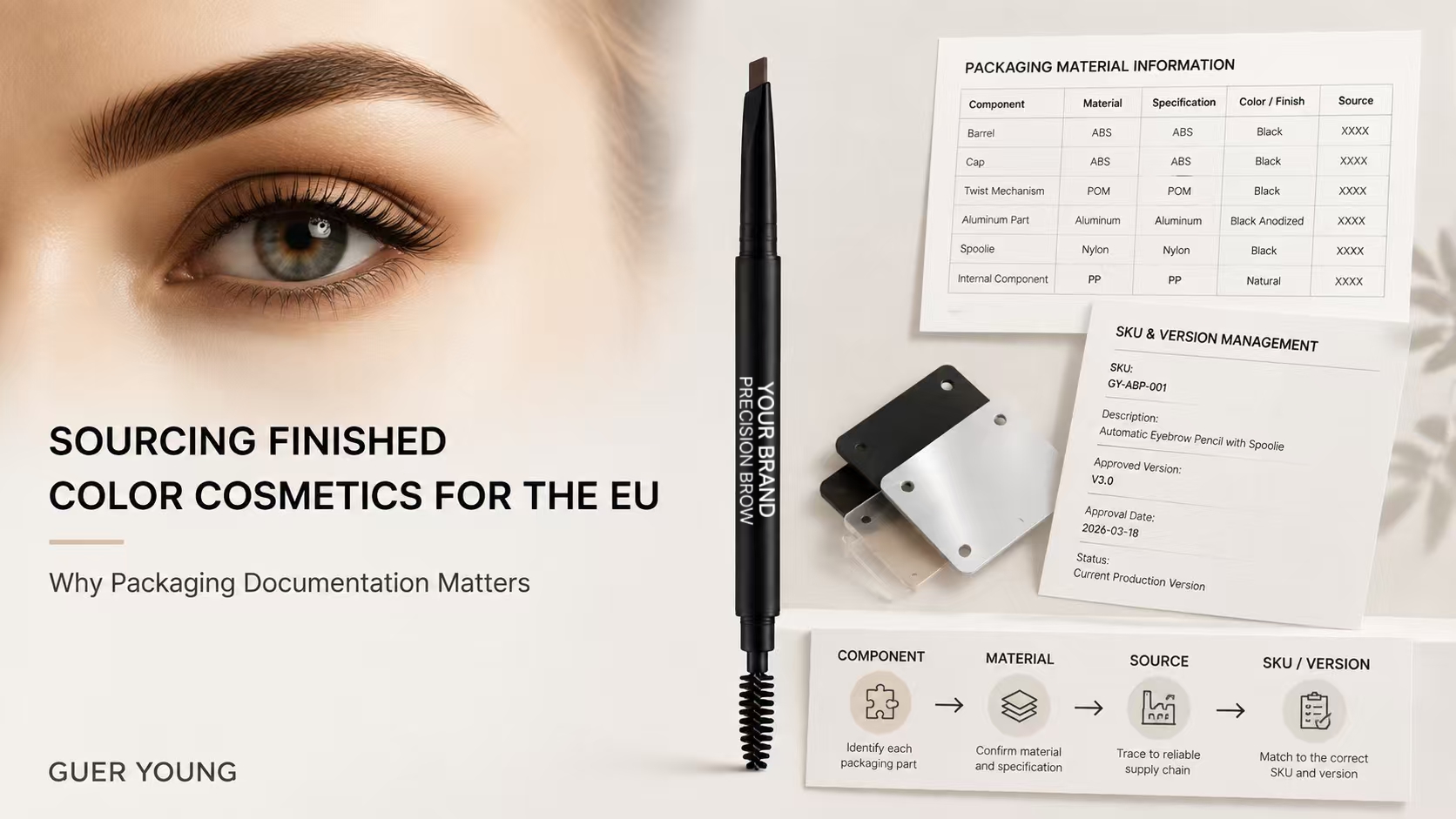
For cosmetic brands, importers, and purchasing managers sourcing finished color cosmetics for Europe, supplier evaluation is no longer just about price, MOQ, shade development, and lead time.
As the EU Packaging and Packaging Waste Regulation (PPWR) brings greater attention to packaging composition, recyclability, packaging minimization, and supporting information, buyers increasingly need to ask a more practical question:
Can your cosmetic supplier clearly identify what each packaging component is made of—and match that information to the product you are actually buying?
For purchasing teams, this is where cosmetic packaging documentation becomes important. The goal is not to create more paperwork. It is to make sure essential packaging information can be found, verified, and connected to the correct finished product when it is needed.
1. “Plastic + Aluminum” Doesn't Tell a Buyer Enough
Take an automatic eyebrow pencil with a built-in spoolie.
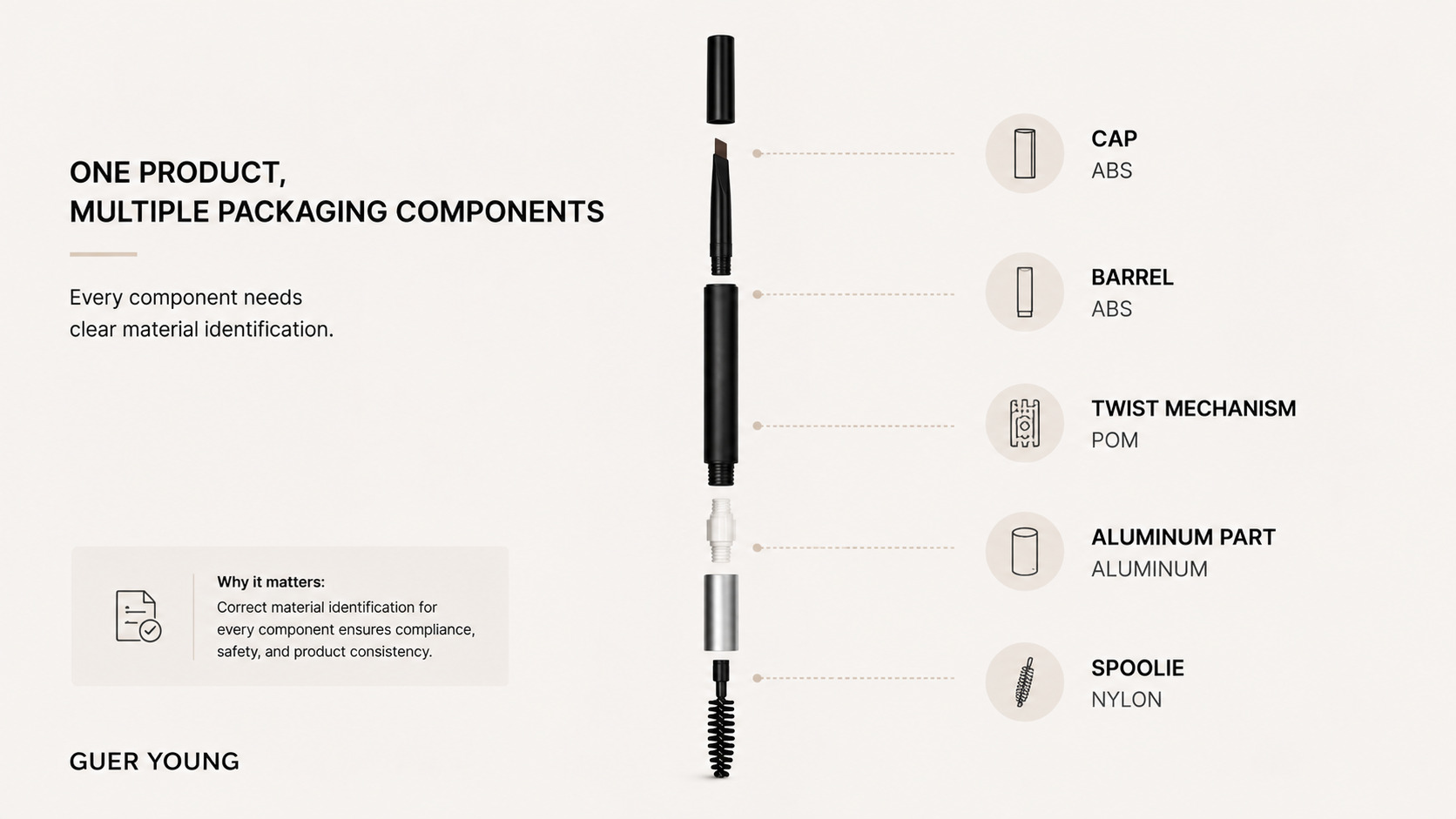
It may look like one simple finished product, but its packaging can contain several components:
Barrel
Cap
Twist mechanism
Aluminum parts
Spoolie
Internal plastic components
These parts may use different materials and may come from different upstream sources.
Now imagine asking your supplier for packaging information and receiving only:
“Plastic + Aluminum.”
Technically, the statement may be correct. For a purchasing manager, however, it is not very useful.
Which part is plastic? What type of plastic is used? Where is the aluminum? What is the twist mechanism made from?
And perhaps most importantly:
Does this information refer to the first development sample or the final version currently in production?
Useful packaging information requirements should create a clearer relationship:
Component → Material → SKU → Approved Production Version
For brands selling in Europe, this makes product information easier to manage for internal reviews, supply-chain traceability, and broader EU cosmetic compliance preparation.
2. A European Eyebrow Pencil Project: The Problem Appeared Before Shipment
We worked with a cosmetic brand that was expanding its distribution in the EU. Its project included several automatic eyebrow pencils with built-in spoolie brushes.
Initially, the purchasing team focused on familiar priorities: pricing, shade accuracy, packaging appearance, and delivery.
During the documentation stage, however, the customer asked:
“Can you document the material of every packaging component and match it to the correct product version?”
The question came from a previous sourcing experience.
In an earlier project with another supplier, the products were already approaching shipment when the customer requested packaging material information.
The answer they received was:
“Plastic + Aluminum.”
No one could clearly explain which component used which material. The customer also could not determine whether the information referred to the first sample or the revised version that eventually entered mass production.
A simple material question had turned into a supply-chain investigation.
The purchasing team had to search previous communications and go back through supplier information to reconstruct basic product data.
For a brand managing multiple cosmetic SKUs in Europe, this creates unnecessary work not only for purchasing, but also for quality, compliance, and sustainability teams.
The real problem wasn't that information never existed. The problem was that it wasn't organized around the product the customer was actually buying.
3. How GUER YOUNG Managed the Project Differently
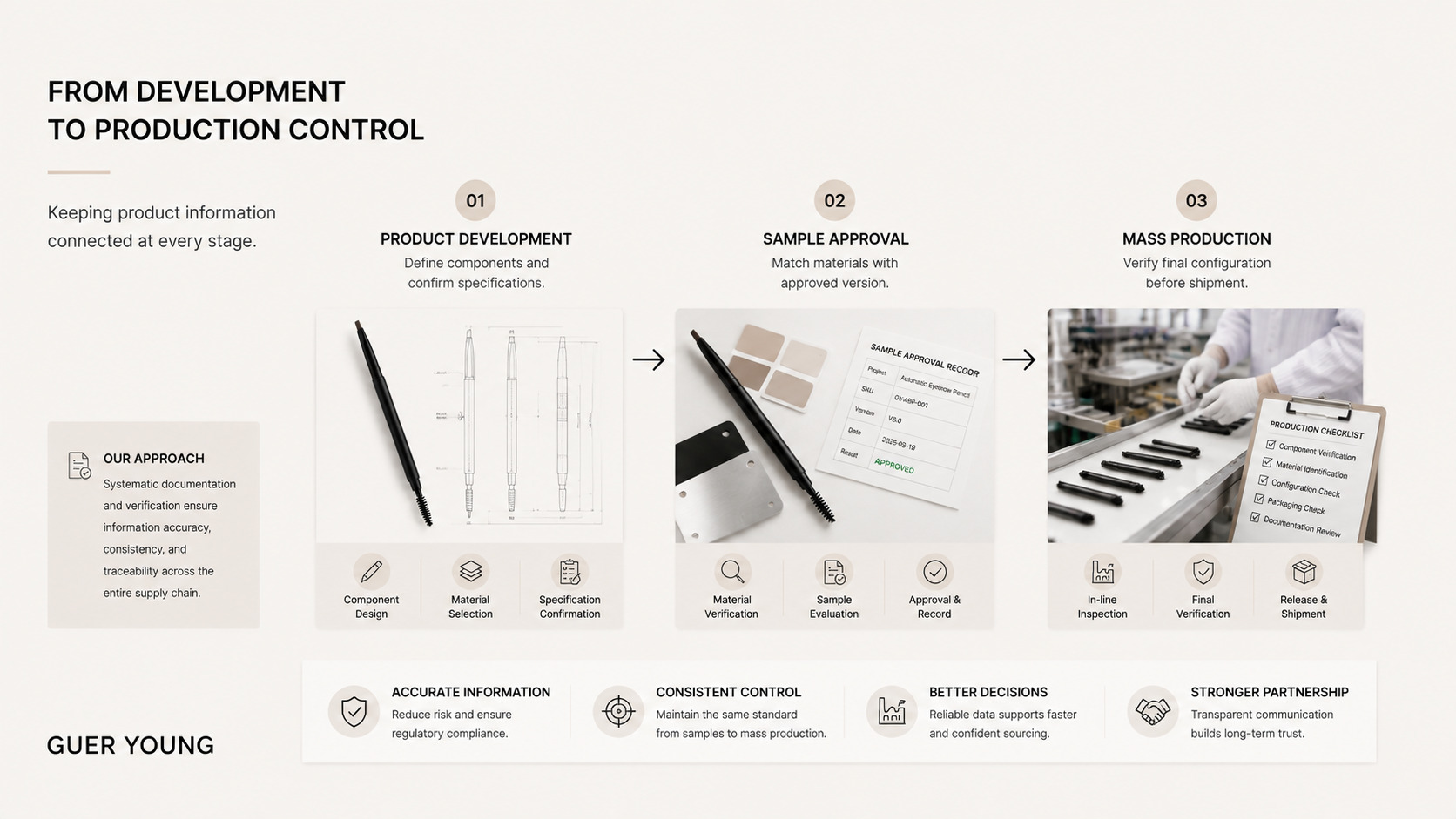
For this project, GUER YOUNG did not wait until shipment to start organizing cosmetic packaging documentation.
The process started during product development.
During Sampling: Identify Components and Materials
We first separated the eyebrow pencil packaging into its relevant components, including the barrel, cap, twist mechanism, aluminum parts, and spoolie.
The corresponding material and sourcing information could then be confirmed at component level.
Component → Material → Source
This provides much more useful information than a general description such as “Plastic + Metal.”
After Approval: Connect the Information to the Product
Cosmetic projects often change during development.
A surface finish may be adjusted. A color may change. A component may be replaced. Packaging details may be revised after the first sample.
After sample approval, the confirmed packaging structure, materials, colors, and surface finishes can therefore be matched to the relevant SKU and approved version.
Material → SKU → Approved Version
This helps avoid a common problem: the physical product has changed, but the documentation still describes an earlier sample.
Before Mass Production: Verify Again
Before mass production, the actual packaging configuration can be checked against the information already recorded.
Production Version → Documentation Check → Update if Changed
If a relevant component, material, or sourcing detail changes, the record can be updated while the project is still active instead of being reconstructed months later.
In the end, the customer received more than finished eyebrow pencils.
They also had packaging information connected to the actual product, relevant SKU, and production version they were purchasing.
The customer later told us:
“What gives us confidence isn't only that you can manufacture the eyebrow pencils. It's that when we ask a material question, you can quickly tell us where to find the answer.”
4. Cosmetic Packaging Documentation Checklist for Buyers
What should an importer or purchasing manager actually ask a cosmetic supplier to provide?
The exact documentation will depend on the product, packaging configuration, applicable requirements, and each company's responsibilities in the EU market.
But a practical buyer checklist can start with:
Component name — What part of the finished product does the information refer to?
Material type — What is the component made from?
Material specification — Is more detailed material information available where relevant?
SKU — Which finished product does the information belong to?
Approved version — Does it reflect the product currently being purchased?
Color and surface finish — Are relevant packaging finishes clearly identified?
Source information — Can sourcing details be identified when required?
Change record — Is the information updated when a material or component changes?
The objective is not documentation for documentation's sake.
What matters is whether the information is:
Specific → Traceable → Current → Connected to the Finished Product
That distinction becomes increasingly valuable as a brand's product portfolio grows.
5. What Should You Ask Your Cosmetic Supplier?
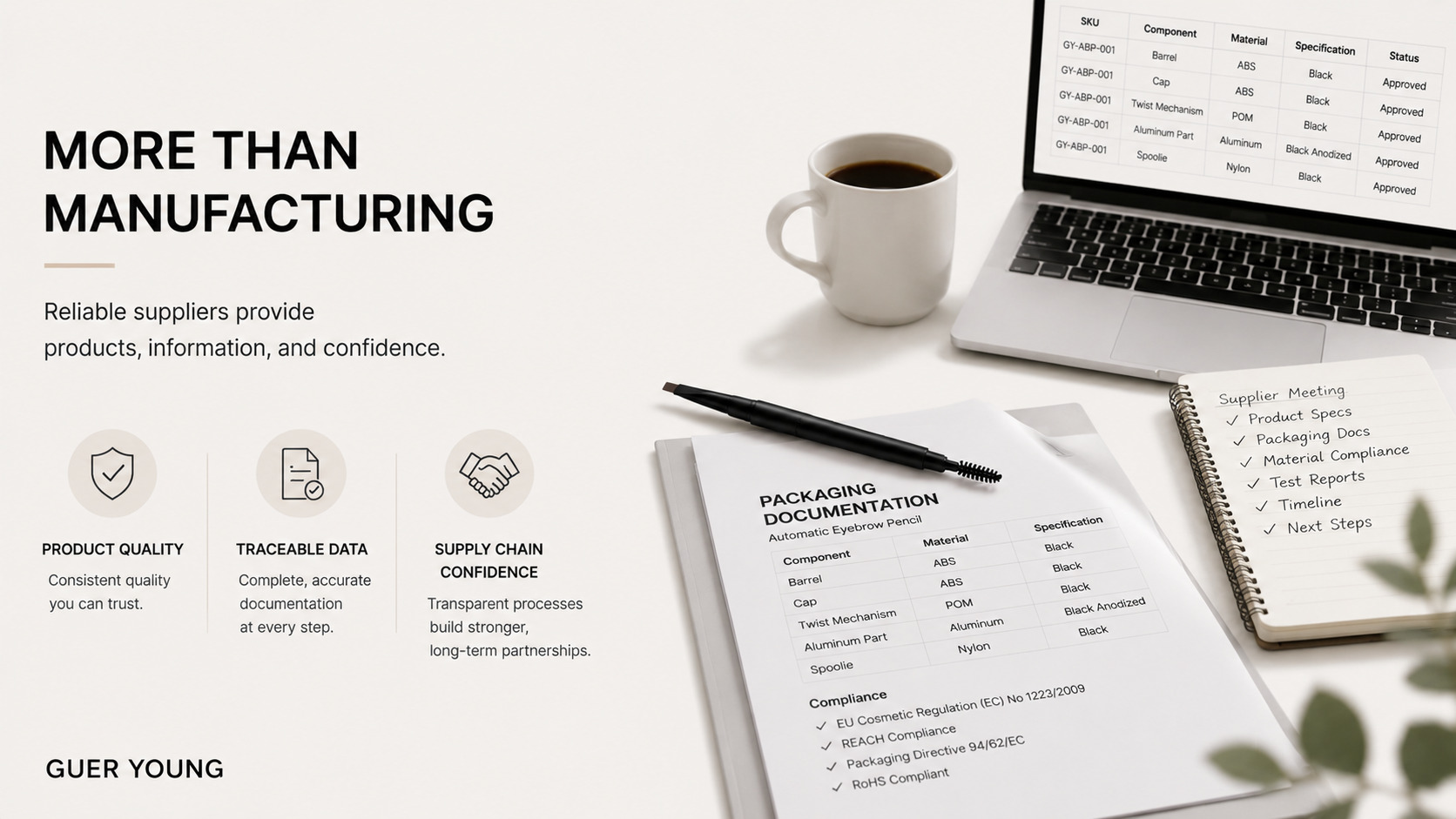
A professional eyebrow pencil factory needs manufacturing capability. But manufacturing and information management are not the same thing.
There are two questions buyers should consider:
Manufacturing capability:
Can you make the product according to the approved specification?
Supply-chain information capability:
Can you clearly explain what was used and locate the relevant information when we need it?
For brands evaluating a reliable cosmetic supplier, the second question can easily be overlooked during early sourcing.
But imagine managing 30 or 50 finished cosmetic SKUs.
If packaging information is requested only when products are ready to ship, the supplier may need to contact upstream vendors again, search previous development records, compare different sample rounds, and determine which information is still current.
A more manageable approach is to build information management into the sourcing process:
Sampling → Confirm components and materials
Sample Approval → Connect information to the approved product
Pre-Production → Verify against the production configuration
Change Management → Update relevant information when something changes
For purchasing teams, this turns documentation from a last-minute request into part of normal supplier management.
So alongside the usual questions about MOQ, price, shade matching, customization, and lead time, consider asking:
“Can you identify the material used for each packaging component and connect that information to the exact product version we are purchasing?”
How a supplier answers can reveal a great deal about how the project is managed behind the factory floor.
Better Supplier Management Makes Documentation Easier
PPWR is bringing greater attention to packaging across the EU. For cosmetic buyers, however, the practical response does not have to begin with a last-minute compliance request.
It can begin during sourcing.
Ask what packaging information your supplier can provide. Check whether that information is connected to the finished product. And understand how changes are managed between sampling and mass production.
At GUER YOUNG, we treat packaging information management as part of finished color cosmetic development rather than something to consider only before shipment.
Because for a purchasing team, a good supply chain does more than deliver products on time.
It means you don't have to start from zero every time someone asks a product question.
Sourcing Finished Color Cosmetics for the EU?
If you are developing eyebrow pencils, eyeliners, or lip liners for the European market, talk to GUER YOUNG about your product requirements, target market, and sourcing needs.
We can support your finished cosmetic project from development through mass production, with clearer product information, SKU coordination, and more manageable supplier communication.


andy.li@gueryoung.com

We have 10 years of experience, focusing on the development and sales of high quality eyelash growth serum, mascara, eyebrow gel, eyebrow color and other products. We also offer custom services, from tube
design to cosmetic fillings and packaging


Room 1, C3 Factory Building, No.8803 Zhuhai Avenue, Lianwan Industrial Zone, Pingsha Town, Gaolan Port Economic Zone, Zhuhai, Guangdong,China
QUICK LINKS
D Zone,5/F, NO.8 CuiZhu 5th Street,
Qianshan Xiangzhou District,Zhuhai,
Guangdong,China,519070

lynn.zhou@gueryoung.com
winnie.zhong@gueryoung.com
niki.xu@gueryoung.com