
Approved Your Eyebrow Pencil Sample? What Should You Check Before Mass Production?

Read in English | Lire en Français | Lesen auf Deutsch | Leer en Español | Leggi in Italiano | Lees in het Nederlands
For European beauty brands, importers, and purchasing managers developing a private label eyebrow pencil, approving the final sample is an important milestone.
The shade looks right. The payoff feels natural. The pencil core has the right balance of softness and firmness. The retractable mechanism works smoothly.
But an Approved Sample proves only one thing:
The factory successfully made those samples.
It does not automatically prove that 50,000 or 100,000 units will perform the same way.
For a professional eyebrow pencil manufacturer, the real challenge begins after sample approval: turning one approved product into a repeatable standard that can be controlled throughout mass production — and reproduced again for future orders.
A Good Sample and 100,000 Consistent Units Require Different Capabilities
Laboratory sampling is highly controlled. Technicians work with small quantities and can fine-tune shades, texture, and application until the desired result is achieved.
Cosmetic mass production introduces a different set of variables.
Batch size increases. Raw-material variation, mixing efficiency, temperature, processing time, forming, and cooling conditions can all influence the finished pencil.
At the same time, the factory must manage pencil-core production, component assembly, in-process QC, packaging, and changeovers between multiple SKUs.
So the important question for a purchasing manager is not simply:
“Can you make this eyebrow pencil?”
It is:
“How will you make sure 100,000 units remain consistent with the sample we approved?”
That question tells you much more about a supplier's actual manufacturing capability.
Project Snapshot: 6 Shades, 100,000 Eyebrow Pencils
One European beauty brand approached us to develop a new eyebrow pencil line.
The project involved:
6 eyebrow pencil shades
Approximately 100,000 units for the initial order
Several visually similar brown shades
Retractable pencil packaging
Potential repeat orders
The sampling stage went smoothly. The shades were approved, the payoff looked natural, the pencil cores had the expected balance of softness and firmness, and the retractable mechanisms operated well.
After approving the samples, however, the purchasing manager raised the question that mattered most:
“The samples are good. How will you make sure the 100,000 production units stay close to what I approved?”
This changed the focus of the project.
The next step was no longer about making another good sample. It was about translating the approved result into something that production and QC teams could consistently follow.
GUER YOUNG reconfirmed the final formula version for each shade, the approved color references, pencil-core characteristics, packaging specifications, mechanical performance, labels, cartons, and SKU correspondence before moving forward.
The six similar shades required particular attention. Each pencil core needed to remain linked to the correct component, shade identification, label, carton, and other SKU information throughout production and packing.
At the same time, shade consistency alone was not enough. Pencil-core condition, breakage risk, and retractable performance also needed to remain within the expected product standard.
This project illustrates an important point for buyers:
An Approved Sample is a product reference. Mass production requires a control system around that reference.
Here are the main areas purchasing teams should examine before approving bulk production.
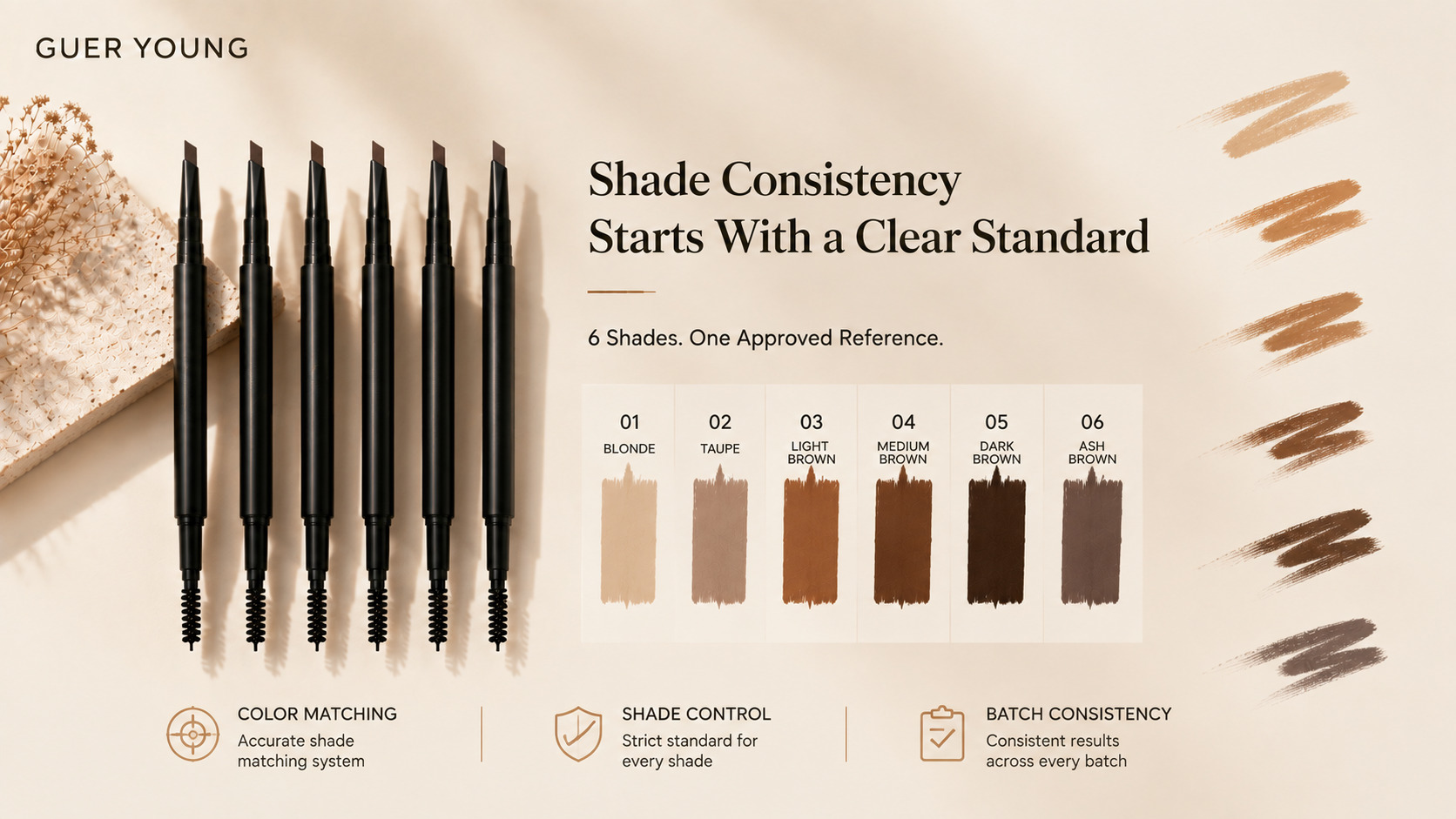
1. Shade Consistency: Will the Same Brown Stay the Same Brown?
Eyebrow pencil shades are sensitive to small color shifts.
Natural Brown, Dark Brown, and Ash Brown may appear close in the package, but even a slight change in undertone can become noticeable once applied.
Raw-material batches, weighing, pigment dispersion, and processing conditions can influence the final shade. That means bulk production cannot rely on a judgment such as “it looks close enough.”
For the six-shade project, maintaining a clear approved reference for each shade was particularly important because several colors were visually similar.
Initial production should be compared against the approved reference, while future repeat orders should also have traceable standards for comparison.
Buyer check:
How do you compare bulk-production shades with the Approved Sample, and what reference will you use for my next order?
2. Pencil-Core Hardness Can Change Color Payoff
A pencil core that is too soft may deposit too much color or deform during use. If it is too hard, payoff may become weak and consumers may need to apply more pressure.
A well-performing laboratory sample does not automatically guarantee identical performance in a larger production batch.
Processing temperature, mixing time, forming, and cooling conditions can all influence pencil-core characteristics.
This is why a capable eyebrow pencil factory needs to manage relevant production conditions and inspect product performance during and after manufacturing rather than relying only on how the original sample felt.
Buyer check:
How do you control pencil-core hardness and payoff during mass production?
A specific explanation of the process is more useful than simply hearing, “Our operators are experienced.”

3. No Breakage in the Samples Does Not Mean No Breakage in Bulk
Several samples can perform perfectly without revealing what may happen across a much larger production run.
Pencil-core strength, assembly pressure, component fit, transportation, and temperature exposure can all contribute to breakage risk.
This matters particularly for retractable eyebrow pencils. Consumers repeatedly twist the core up, apply the product, and carry it under different conditions.
A reliable cosmetic supplier should therefore look beyond appearance. Pencil-core performance, assembly condition, and functional use all need attention before shipment.
Buyer check:
What controls or inspections do you use to identify pencil-core breakage risks during production?
4. Retractable Mechanisms Need to Work at Production Scale
A retractable eyebrow pencil combines cosmetic formulation with mechanical packaging.
The formula can be excellent, but if the mechanism sticks, spins without advancing, or fails to raise the pencil core correctly, consumers will still see a defective product.
Packaging components also have manufacturing tolerances.
A handful of sample mechanisms working smoothly does not guarantee identical performance across tens of thousands of assembled units.
For this reason, the pencil core, components, assembly condition, and twist-up performance should be evaluated together rather than treated as completely separate quality issues.
Buyer check:
How do you check twist-up, advancement, and retraction performance during production?
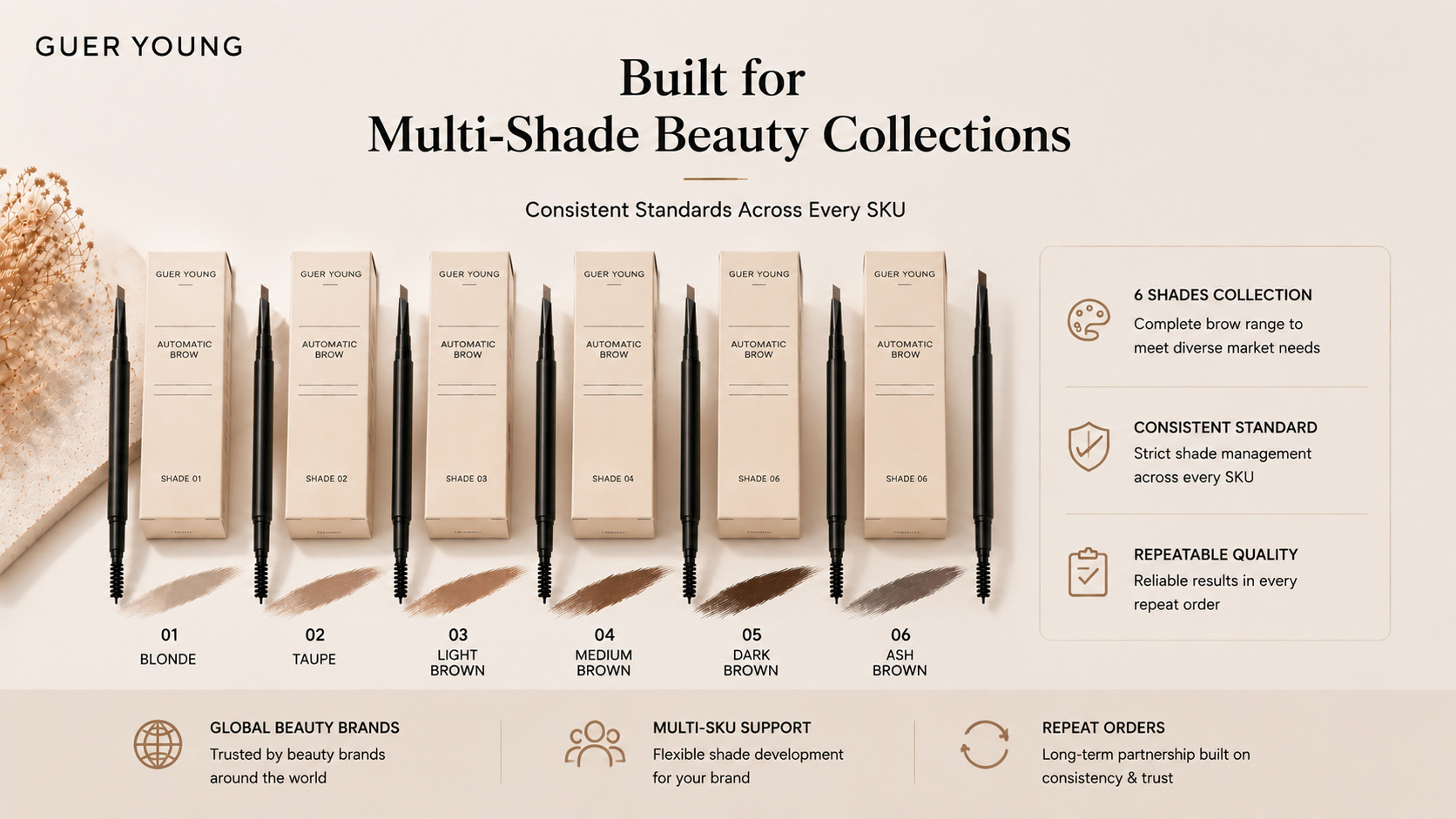
5. Similar Shades Make Multi-SKU Control More Important
For the European project, six shades created a risk that had little to do with formulation itself.
The correct pencil core could be assembled into the wrong component. Natural Brown could receive a Dark Brown label. A correct finished pencil could be packed into the wrong carton or assigned the wrong barcode.
When several visually similar shades are produced together, these errors become harder to detect through appearance alone.
That is why multi-SKU management is part of quality control.
For multi-shade private label eyebrow pencil projects, GUER YOUNG links SKU identification with production materials, packaging information, and QC checks to reduce the risk of mix-ups during manufacturing and packing.
Buyer check:
How do you separate and verify similar shades throughout production, assembly, and packaging?
6. The Reorder Is the Real Test of Batch Consistency
A successful first production run is important, but the second and third orders can reveal even more about a manufacturer's capabilities.
If every reorder requires the shade to be interpreted again or the pencil-core characteristics to be adjusted from scratch, quality risk and supply-chain costs increase.
A mature cosmetic mass production system should retain approved references, relevant production information, and quality requirements so future batches can be produced against an established standard.
For a European brand planning to keep an eyebrow pencil line in the market, this matters just as much as the quality of the first shipment.
Buyer check:
If we reorder six months from now, what will you use to ensure the new batch remains consistent with the original approval and first production run?
Batch-to-batch consistency is one of the clearest indicators of whether a supplier can support a long-term program.
How Should an Approved Sample Become a Production Standard?
An Approved Sample should not simply be placed in a sample cabinet.
The approved product needs to be translated into information that manufacturing and QC teams can follow, including:
Final formula version
Approved shade reference
Key processing conditions
Pencil-core characteristics
Packaging specifications
Mechanical performance requirements
SKU identification
Label, carton, and barcode correspondence
Relevant inspection requirements
Before production begins, the approved version should be reconfirmed. Initial production can then be compared against the reference, critical points monitored during manufacturing, and finished products checked again before shipment.
At GUER YOUNG, sample approval, mass-production control, multi-SKU management, and quality management are treated as connected stages of the same project.
The objective is not simply to remember what the Approved Sample looked or felt like.
It is to turn customer approval into a repeatable manufacturing reference.
8 Questions to Ask Before Eyebrow Pencil Mass Production
If you are evaluating an eyebrow pencil manufacturer, these questions can help determine whether the supplier is ready to move from samples to a bulk order:
How is our Approved Sample converted into a mass-production standard?
How will production shades be compared with the approved reference?
How do you control pencil-core hardness and color payoff?
What checks are used to reduce pencil-core breakage risk?
How is the retractable mechanism checked during production?
How do you prevent mix-ups between similar SKUs?
How do you maintain batch-to-batch consistency for repeat orders?
If a deviation occurs, can it be traced through production and QC records?
A supplier prepared for long-term cooperation should be able to explain what is controlled, when it is checked, how it is evaluated, and what happens when a deviation is found — rather than simply saying, “We have QC.”
The Approved Sample Is the Starting Point, Not the Finish Line
For European beauty brands, importers, and purchasing managers, a great Approved Sample is important.
But ultimately, you are not buying one perfect eyebrow pencil.
You are buying the ability to reproduce an approved product at scale.
The 100,000-unit, six-shade project illustrates why this distinction matters. Shade consistency, pencil-core hardness, breakage risk, retractable mechanism performance, multi-SKU control, and batch-to-batch consistency all have to move from “the sample looks good” to defined production controls.
Before moving into bulk production, ask your supplier one more question:
“How will you turn this Approved Sample into a repeatable production standard?”
If you are developing a Private Label Eyebrow Pencil for the European market — particularly a multi-shade, high-volume, or repeat-order project — send us your target shades, product specifications, number of SKUs, and estimated order volume.
We can evaluate your project from sample development through stable mass production.


andy.li@gueryoung.com

We have 10 years of experience, focusing on the development and sales of high quality eyelash growth serum, mascara, eyebrow gel, eyebrow color and other products. We also offer custom services, from tube
design to cosmetic fillings and packaging


Room 1, C3 Factory Building, No.8803 Zhuhai Avenue, Lianwan Industrial Zone, Pingsha Town, Gaolan Port Economic Zone, Zhuhai, Guangdong,China
QUICK LINKS
D Zone,5/F, NO.8 CuiZhu 5th Street,
Qianshan Xiangzhou District,Zhuhai,
Guangdong,China,519070

lynn.zhou@gueryoung.com
winnie.zhong@gueryoung.com
niki.xu@gueryoung.com